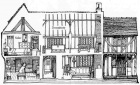
Objects from our collection
From time to time as news items we have featured objects from our collection. Here are some of them.
- 2022 – 04 Painting Links Gayer-Anderson to the Tenement Years
 Richard Poulson was born in Little Hall in 1923 when his family lived in one of the tenements. They moved out and the Gayer Andersons started restoration. He and other children would visit Little Hall, where the Colonel was then living, on their way home from school. He is photographed here by Colonel Gayer Anderson,… Read more: 2022 – 04 Painting Links Gayer-Anderson to the Tenement Years
 - Decorative Bridal Mirror Box Panels
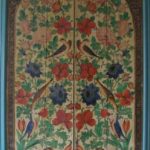 When the Gayer-Anderson brothers undertook the restoration of Little Hall in the 1930s they fitted out a number of its rooms with architectural features and decorative pieces. The items were collected on their travels in Egypt and the Middle East. One such room, which they called ‘the Study’, now known as the Panelled Room, was fitted… Read more: Decorative Bridal Mirror Box Panels
 - Evacuees Chest
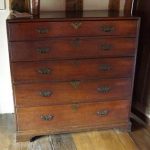 Now that we’ve upgraded our website we’re going to introduce an object each month that we think will interest you. As you may have seen elsewhere, Little Hall’s Second World War history was to feature in an exhibition this month so our object for May relates to this era. The Chest of Drawers with a… Read more: Evacuees Chest
 - Indian Tiles
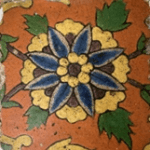 The cuerda seca Indian Tilesembedded in the walls of the Colonel’s Study Like many of our treasures, we continue to learn more about them. These tiles have always been on view in the Colonel’s study but in 2018 Arthur Millner came to photograph the Little Hall examples for a book he was writing. Last November… Read more: Indian Tiles
 - Little Hall Garden
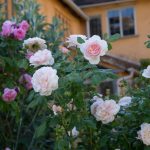 Little Hall is nearly 650 years old and over time has had many and varied owners. The last residents before the property finally passed out of private hands and into the possession of the Suffolk Building Preservation Trust in 1975, were twin brothers named Gayer Anderson. They bought the property in 1925, restored it as… Read more: Little Hall Garden
 - Little Hall’s Window Glass, Old and New
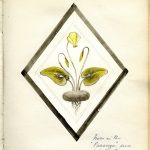 The Gayer-Anderson twins moved into the Great House in 1923 but had to wait until 1931 when the tenants vacated no.20 in the North wing of Litle Hall before they could start to restore it. In 1934 the residents of no 23-24, Mrs and Mr Bye, died which left the rest of the property clear… Read more: Little Hall’s Window Glass, Old and New
 - Object of the Month: Praying Child
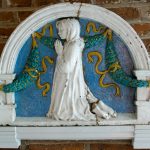 As visitors to Little Hall leave the library, they see mounted on the chimney of the inner hall fireplace a semi-circular relief of a girl kneeling in prayer. This was rescued from a demolition site in London in 1917 by Major Robert Gayer-Anderson, who saw it by chance lying in three pieces on a pile… Read more: Object of the Month: Praying Child
 - Painting of a young man, by Glyn Philpot RA
 Portrait of a Young Man by Glyn Warren Philpot (1884-1937) In the Well Room at Little Hall, Lavenham, the former home of twins Robert and Thomas Gayer-Anderson, hangs a portrait of a young man by the artist Glyn Warren Philpot. The portrait, a gift to Thomas Gayer-Anderson from Philpot is undated but appears stylistically to… Read more: Painting of a young man, by Glyn Philpot RA
 - Recording the past at Little Hall
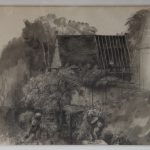 Paintings, drawings maps and photographs often provide a valuable record of changes to buildings and landscapes. Reginald Brill’s picture ‘Mr Turner restoring the Barn’, in the dining room of Little Hall, records two of the Italian lead statues that were formerly on the garden terrace of the Hall. Brill’s viewpoint was on the first floor… Read more: Recording the past at Little Hall
 - The Changing Face of Little Hall
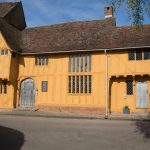 Since the Gayer-Anderson brothers arrived in Lavenham, Little Hall has been through a succession of changes, and especially in the face it presents to the Market Place. We can see how it looked in 1929 by clicking through to this aerial photo. The picture above was probably taken around 1980, showing the colour, close to… Read more: The Changing Face of Little Hall
 - The Gayer Anderson Crests
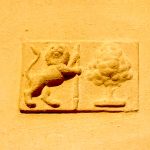 On the external walls of Little Hall there are a number of pargetted crests set into the plasterwork. These depict a lion and a tree and are the combined emblems of the Gayer Anderson family. The tree symbol is said to come from Egypt and signify ‘home’. Thomas Gayer Anderson wrote in his house guide:… Read more: The Gayer Anderson Crests
 - The Kite Flyer, Thomas Gayer Anderson
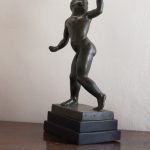 Thomas Gayer-Anderson was a gifted artist who worked in a range of media, including sculpture. At Little Hall he created a studio within a first floor room of the house, and a workshop within the garden. It was probably within the latter that he made a model in clay, of a naked boy, to which… Read more: The Kite Flyer, Thomas Gayer Anderson